I am not here to please everyone.
I have been learning a lot about the reading world over the past year, and I understand how segmented the market is, reflecting broader trends around micro-targeted media consumption. I know I will be speaking to a small segment of the overall reading population, and it is more important for me to find the readers my work appeals to than to try to make my novels appeal to everyone.
So, I am going to spend a little bit of time breaking down each of the seven types of my readers and you can judge for yourself whether you should give my novels a chance or not.
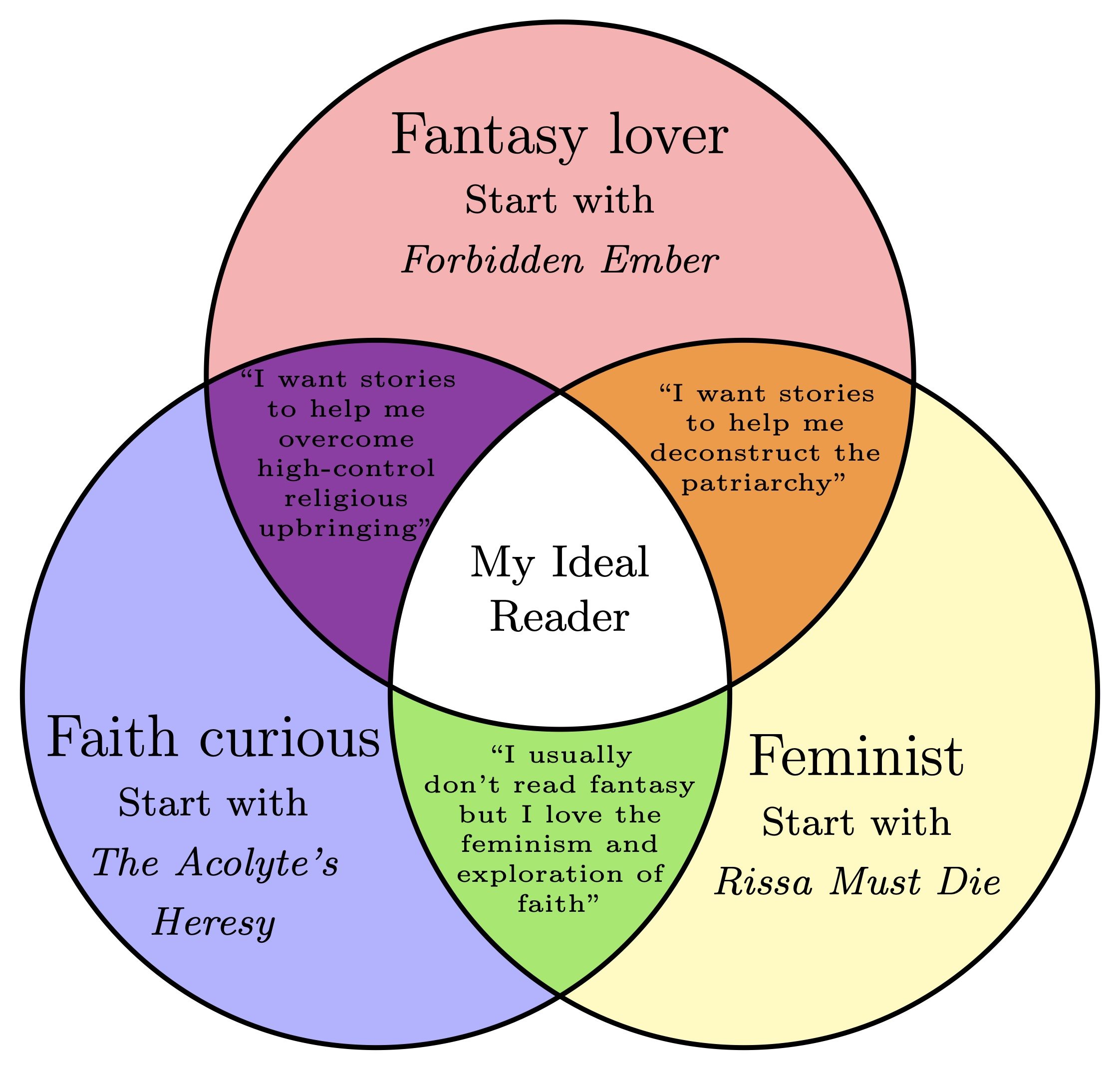
A Venn diagram of my Seven Types of Readers. Author original, made using the TikZ package in LaTeX.
My Ideal Reader
My “ideal reader” is someone who is faith curious, a feminist, and loves fantasy. If you check all of those boxes and my novels deliver on their promises, then you would be a super-fan of my work. I would also love to hear your thoughts, reactions, and concerns because you are someone I would like my future novels to appeal to.
If you are anything like me, then you probably grew up in a conservative, overtly or subtly patriarchal culture for religious and/or cultural reasons. You have already started doing the work of deconstructing both religious certainty and internalized misogyny. Depending on where you are in your journey, you are looking for characters to root for for inspiration and/or encouragement and/or enjoyment.
My Faith-Curious Fantasy Lover
You love reading fantasy and you are actively doing the work of spiritual deconstruction/reconstruction. In my opinion, once you begin doing this work, it never stops because you can never stop learning about a topic that has no answers. I hope my novels – especially The Acolyte’s Heresy and Forbidden Ember – are one of many guides on your spiritual journey, and I hope a particularly enjoyable one!
Allow me to reiterate my definition of faith-curious here. Faith-curious includes everyone who is approaching faith and religion with an open heart: liberal and progressive people from all faiths, atheist and agnostic people who want to better understand the motivations and worldviews of people of faith, exvangelicals/post-evangelicals, people grappling with purity culture, people leaving high-control religions who want to make sense of what they went through, and people who are in the process of deconstructing faith and/or reconstructing faith.
Faith-curious does not (necessarily) mean you are looking to convert, but that you are curious about how others relate to faith, respect that there are different ways to relate to the mystery of the divine, and are intrigued by how religion has shaped the political and social world we live in and can be a force for good in the world. The opposite of faith is certainty, and the opposite of being curious is “knowing” everything. Faith-curious people do not believe they have all the answers.
My Feminist Fantasy-Lover
You love reading fantasy and appreciate when the author takes into account how the patriarchy and sexism shapes the lived experiences of the female characters, but you are not particularly interested in exploration of faith. You are always looking for more novels that deconstruct the patriarchy by treating female characters as complex and multi-faceted as male characters have traditionally been treated, and deftly subverting gender tropes.
All three of my novels are for you in that sense, but The Acolyte’s Heresy might be too heavy-handed for you with regards to exploration of faith issues. You might stick with Rissa Must Die and Forbidden Ember first. But if you enjoy those two, then I would bet you’d end up reading The Acolyte’s Heresy.
I want it to be clear that male readers are welcome to enjoy my novels as well. I would be thrilled if you feel like after reading my novels you understand something new or better about a woman’s lived experience.
I also should make it clear that my characters are not living in a gender-equal utopia. Writing fantasy as a feminist for feminists means that my female characters are struggling to find their place in the patriarchal, sexist world based on my belief that they deserve the same rights and opportunities as the male characters. It also doesn’t mean all the women always get along. It means that I allow my female characters to be fully three-dimensional (i.e., loving some women, hating others, loving some men, and hating others) as male characters have always been allowed to be.
My Faith-Curious Feminist
If you “don’t usually read fantasy,” then I know I have to deliver even better on the faith-curiosity and feminism because the fantasy tropes and world building are less a source of delight and more a liability in terms of getting into my stories.
Despite the liabilities, let me make the case for why fantasy: I wanted to create my own world so that the world – the setting itself, which includes not only the geographic and physical features, but the political, theological, and magical systems – could be a character I manipulate in service of the stories I wanted to tell. I wanted maximum control over my world so every element of it, not just the characters and the plot but even the setting, could be optimized to reinforce the faith and women-related themes. That is why I write fantasy.
Did I pull it off? Was it worth creating an entirely new world for that? You be the judge of that. I would recommend you leave Forbidden Ember for last, however, given that it is the most fantasy-forward, and start with Rissa Must Die or The Acolyte’s Heresy.
My Faith-Curious, Feminist, or Fantasy-Loving Reader
If you only check one of the three boxes, then I still think you may enjoy my novels, but I do have recommendations for where you should begin!
If you are faith-curious but struggling with feminism and don’t usually read fantasy, then I recommend you start with The Acolyte’s Heresy. It is long, but it is the first novel I wrote and the one where I draw the most on my own spiritual journey of leaving the Unification church. I also wrote it explicitly with the hope that it can help others struggling with purity culture and high-control religions. If you read it, then let me know what you think. Should I lean more into the exploration of faith in my other novels? Did you enjoy the sensitivity to women’s perspectives or fantasy tropes more than you expected?
If you are feminist but not particularly faith-curious or into fantasy, then I recommend you start with Rissa Must Die. I always treat my characters’ faith seriously and not as a plot device, but exploration of faith issues is not a central theme of this novel. The “magical” elements are also less central. It is still fantasy in the sense that I made up the world, but it deals more with the challenges of being a professional woman in a male-dominant workplace. Let me know if you want more of my novels even if the faith and fantasy aspects are dialed up more.
If you are a fantasy-lover but indifferent about faith and feminism, then I recommend you start with Forbidden Ember. I wrote this explicitly because I wanted to write a novel that had more magic in it! There is still some discussion of faith, but it has more to do with universal themes like human agency versus “God’s will,” how religion intersects with politics, and who gets to be a part of the in-group. Having said that, if you read it all the way through, then I would absolutely love to know what you thought of the ending. Did it work for you? Would you like to see more exploration of faith in my future novels?